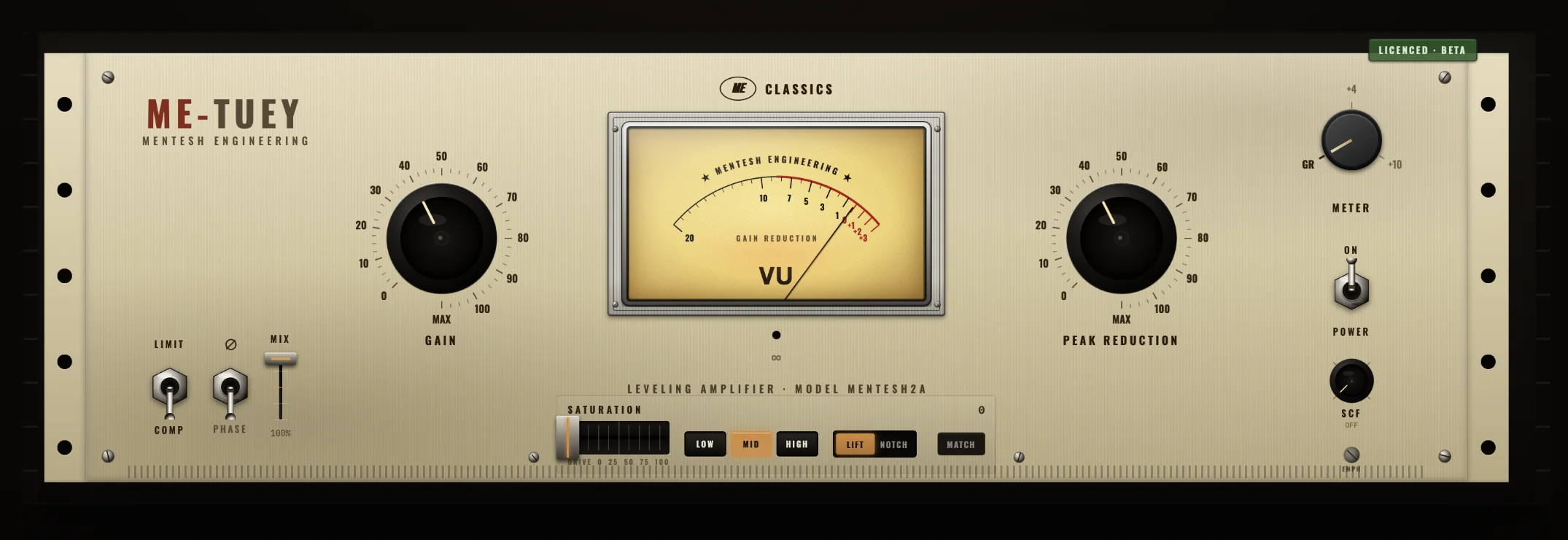
Analytical model from physics equations + measurements on our specific unit. Captured at 96 kHz, 24-bit against a level-matched dry. Tube cascade after Bendiksen Eq 4.13 (Pakarinen-Yeh- Bendiksen, DAFX §4.3.1). Output stage tanh soft-clip with the ceiling fitted to −2.18 dBFS. Sidechain shaping via Zölzer one-pole shelves and an RBJ biquad peak EQ. Three-branch τ opto envelope, R² = 0.85–0.97 per branch. Two-regime Peak Reduction preserved. Multiband parallel saturator built in.
First 100 purchases at $69 · $149 list · 14-day refund
Loading ME-TUEY
Faceplate live · drag the knobs · toggle variants from TWEAKS · audio plays inside your DAW
· Evidence
Bring your own ears.
The unit and the plugin. Same source. Side by side. RMS-matched so you compare character, not loudness.
Three sources (vocal, bass, drums). Eleven Peak Reduction points each. Drag the knob, A/B Hardware ↔ Plugin instantly. Try blind mode if you want to be honest with yourself.
MIXWet/dry blend, 0 – 100 %. 50 % is the mix-bus default.
02·5Faceplate finishes
One unit. Five photocells.
The audio path is the captured 2014 UA reissue — every variant runs the same tube cascade, the same transformers, the same saturation engine. What changes per face is the photocell. Real LA-2As differ from each other for exactly this reason: the T4B cells age and respond on their own time curves. Five photocells is five units in your unit.
Each face also carries small HF and LF tilts — modeling natural variance in transformer + cell response across real units. Silver is the modded reference (Sowter 8940 + RCA NOS = bright sweet, no tilt). Other faces sit slightly warmer or brighter at the top, with a touch of LF cut on the mix-bus voicings (Purple, Cream).
Each face also loads a starting knob snapshot — Peak Reduction, Gain, Mode, Saturation — tuned for the source you’re reaching for it for. Switch finishes mid-session: TWEAKS panel, one click, photocell + tone tilts + snapshot swap together.
Identical across all five
Tube cascade — V1A, V1B, V2A, V2B
T1 input + T2 output transformers
Saturation engine, soft-knee math, GR ceiling
Sidechain HPF + R37 emphasis shelf
Gain calibration (kTubeChainDb = 34.67 dB)
THD @ 0 VU: 0.35% · h3 dominant
Differs per face
Photocell time-constants— attack and release τ values, scaled relative to the captured Silver unit (atk ×0.70 to ×1.50, rel ×0.48 to ×2.00)
Output HF tilt— small high-shelf at the output stage modeling transformer + cell HF response variance. Range −3 dB to +1 dB, corner 5–8 kHz. Silver is neutral.
Output LF tilt — small low-shelf for mix-bus and vintage feel (Purple −2 dB @ 60 Hz · Cream −1 dB @ 80 Hz). Silver, Grey, Black are neutral.
Starting knob snapshot — PR, Gain, Mode, Saturation positions loaded on selection
That’s the whole list.
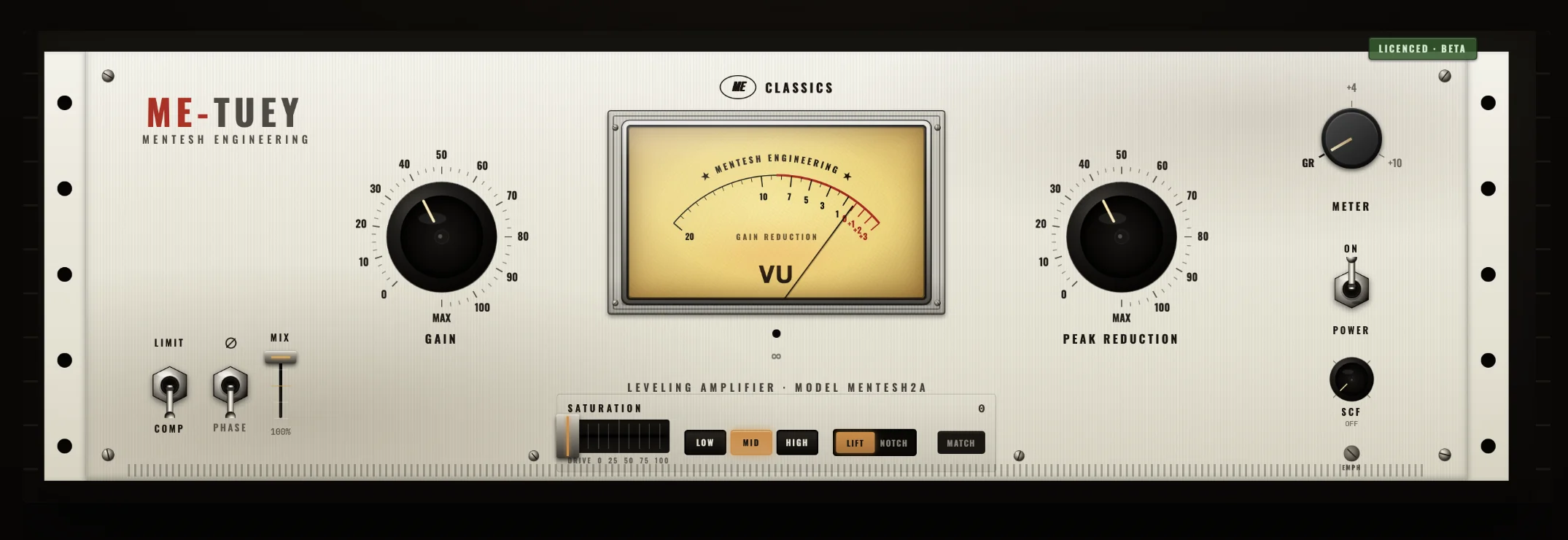
Silver (1960s)
captured
The unit. Neutral starting point.
Cell character
τ atk ×1.00 · rel ×1.00
Attack
10 ms
Release
60 ms + 2.5 s
HF tilt
neutral
LF tilt
neutral
Loads with
Peak Reduction
40
Gain
40
Mode
Compress
Saturation
off
The 2014 UA reissue, neutral knob positions. Where every measurement traces back to. Start here for vocals, electric piano, anything you want to sound like the records you grew up on.
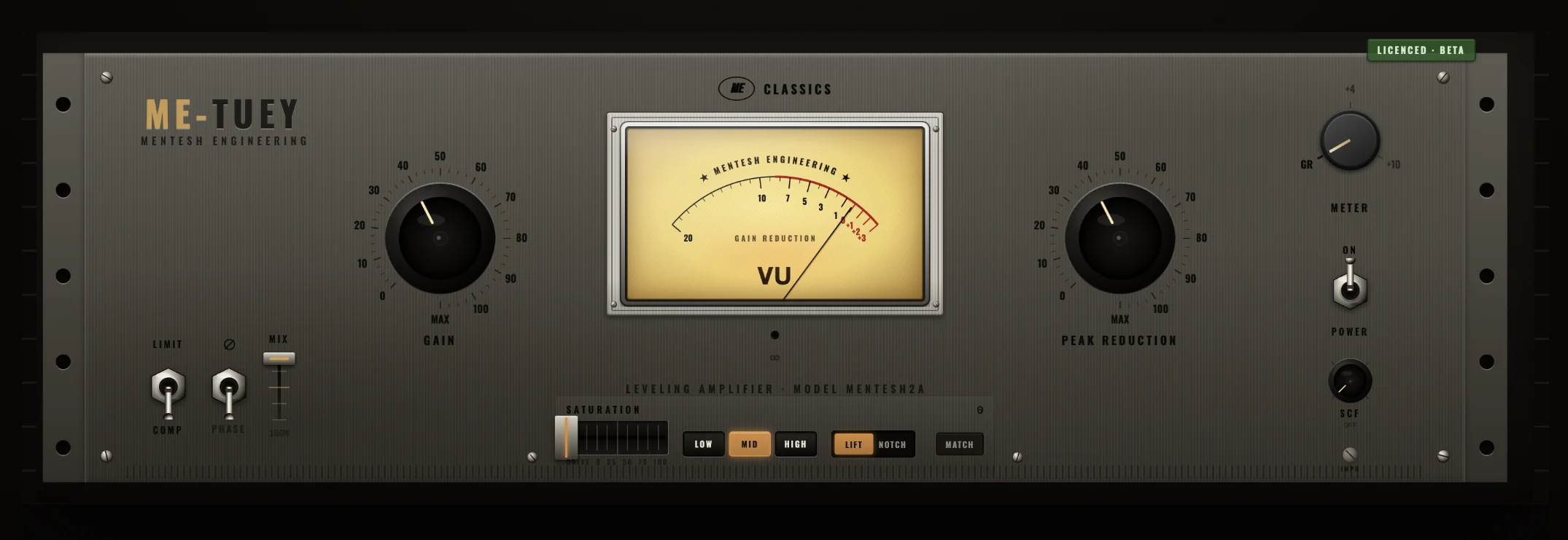
Grey (UA era)
Vintage starting point.
Cell character
τ atk ×1.20 · rel ×1.60
Attack
12 ms
Release
60 ms + 4 s
HF tilt
-2 dB @ 6k
LF tilt
neutral
Loads with
Peak Reduction
35
Gain
45
Mode
Compress
HF Emph
+light
UA-reissue vibe out of the box. Bass DI that blooms. Pads that breathe. Slight high-frequency lift on the way in.
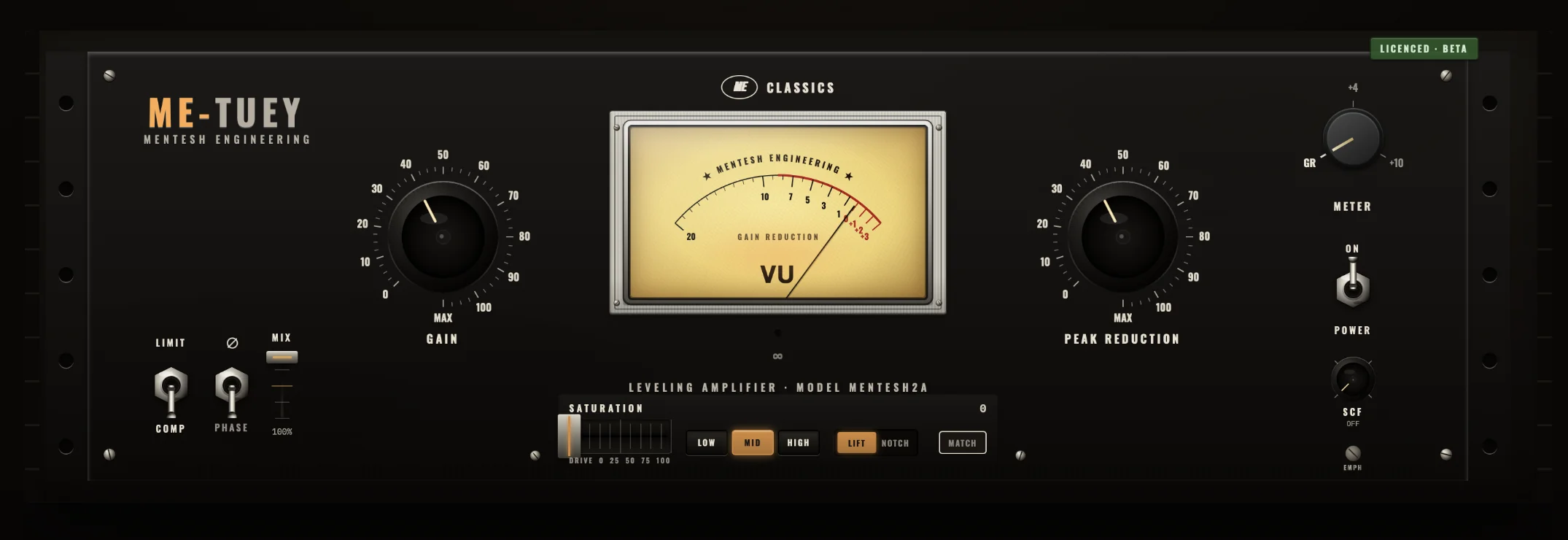
Signature (Black)
House aggressive. Tracking starts here.
Cell character
τ atk ×0.70 · rel ×0.48
Attack
7 ms
Release
50 ms + 1.2 s
HF tilt
+1 dB @ 8k
LF tilt
neutral
Loads with
Peak Reduction
55
Gain
40
Saturation
0.3 · NOTCH
Mode
Compress
House voicing. Hits hard from the moment you instance it. Kick drum, snare, drum bus, aggressive vocal — the starting point for anything that needs to sound finished, not subtle.
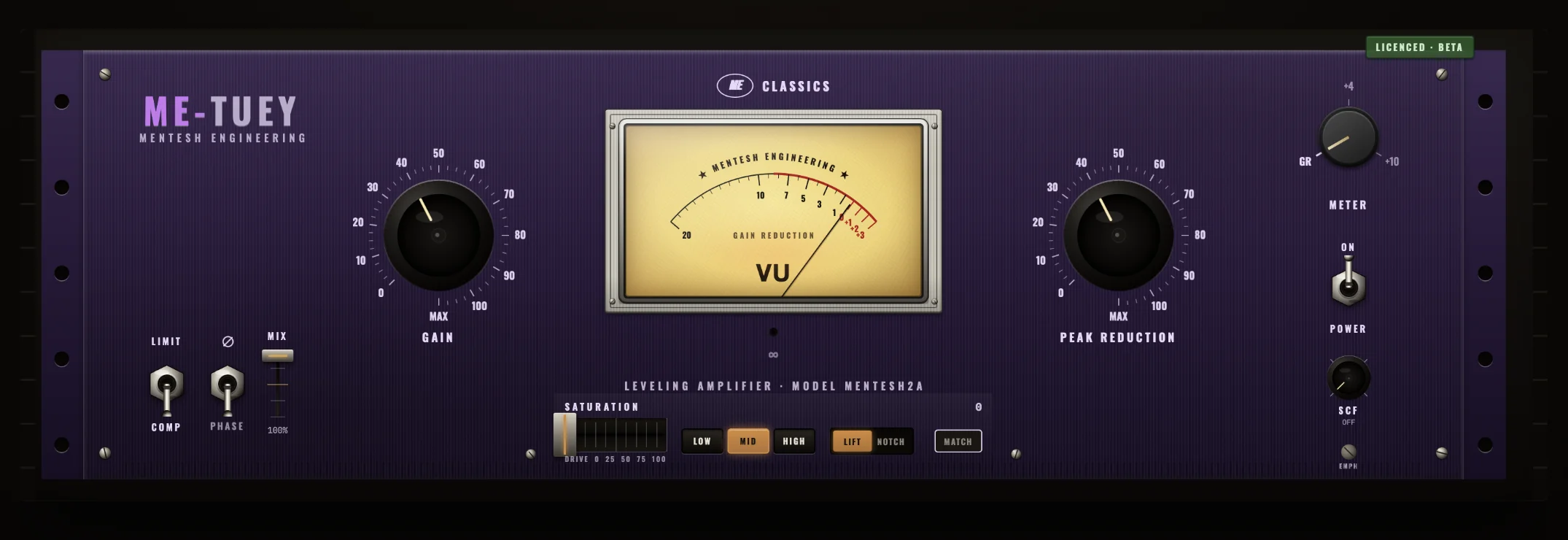
Deep Purple
Creative / colorful. Limit mode.
Cell character
Attack
15 ms
Release
80 ms + 5 s
HF tilt
-3 dB @ 5k
LF tilt
-2 dB @ 60 Hz
Loads with
Mode
Limit
Mix
70%
Emphasis
40
Peak Reduction
60
Limit mode + 70% wet for parallel-style glue. Master bus, tracking room buss, anywhere you want compression to be a flavour, not a control.
Studio Cream
Warm and clean. Saturation off.
Cell character
Attack
10 ms
Release
60 ms + 3 s
HF tilt
-2 dB @ 5k
LF tilt
-1 dB @ 80 Hz
Loads with
Peak Reduction
25
Gain
55
Saturation
off
Mode
Compress
Light compression with the make-up gain doing the work. Acoustic guitars, backup vocals, anywhere you want vintage feel without the unit leaning on the program.
All five ship with v1.0 · no DLC · no upgrade tier · switchable in the TWEAKS panel
03Honest answers
What an engineer actually wants to know.
How is this different from the other LA-2A plugins?
Most leveler plugins emulate an LA-2A — a statistical average across many circuits. ME-TUEY is rebuilt from this LA-2A: one specific 2014 UA reissue (1960s Lawrence circuit) unit, tube-rolled to a known NOS configuration, captured at 96 kHz against a level-matched dry reference. Every coefficient traces to a measurement in our SOP. The two-regime PR curve(fast-attack on transients, mid-release on body) is preserved instead of linearised, which is what most generic emulations do.
Why captured-from-one-unit instead of an average?
Because no two LA-2As sound the same. The unit drift (tube age, photocell history, transformer winding) is the character. Averaging sands it off. We picked a single unit we know — and we publish its provenance (tubes, transformers, capture conditions) so the receipt is auditable.
What about CPU, latency, and oversampling?
Zero-latency feedback design — 0 samples reported to the host. CPU is under 1% per instance at 96 kHz on M-series silicon.
Mac and Windows? Apple Silicon?
macOS: Universal binary (Apple Silicon + Intel x86_64). VST3 · AU · CLAP · Standalone. macOS 11 Big Sur or later.
Boutique-tier price, single-product brand. We are not a marketplace. The launch price reflects the cost of capturing one unit properly, validating it, and shipping a plugin that’s tied to a measurement receipt rather than a marketing brief. The early-bird price ($69) is locked for the first 100 reservations; everyone after pays $149.
04Studio Rack Mode · ME-TUEY · ME-FET · ME-56
Buy one. Grow into a rack.
ME-TUEY ships first. The opto leveler is the keystone. The FET limiter, graphic EQ, channel strips, tape, mastering limiter, and bus compressor follow on a capture-day-driven cadence. Open Studio Rack Mode and the chain stacks inside one window.
· Composite re-rendering against the v1 brand · screenshot returns at v1.0 launch
First 100 reservations lock the $69 launch price. No charge today.
06Listen · evidence
The unit. The plugin. Same source.
36 captures. Three Peak Reduction settings (PR 50 / 70 / 100) across four sources — vocal, bass, drums, acoustic guitar. Same source recording pushed through the unit at each setting, plus the plugin run on the dry input. Natural levels, so the gain-reduction story is what you hear.
Source
Listening to
Peak Reduction
70
5070100
0:000:12
Space play/pauseTab cycle sides←→ change PRLoading clips… 0/9 (0%)
How these were captured
Same dry source through the LA-2A vs through ME-TUEY standalone
96 kHz / 24-bit, no normalization on either side
LA-2A loopback captured through the same I/O chain
Plugin renders use the same loopback stems as input — bit-perfect input matching
Plugin builds rendered through ME-TUEY v1.0.2 (Najnudel DAFx-23 photocell ODE)
RMS-matched per pair (scale factors logged, −9.8 to +3.0 dB)
Reading the comparison
Low PR (0–30): little to no compression — both should sound nearly identical
Mid PR (40–70): the opto character emerges; listen for release tail
High PR (80–100): heavy slam — listen for harmonic content + release-program dependence
Audio plays back at 48 kHz / AAC 192 kbps for streaming weight
07Engineering · the receipt
Every claim has a number. Or it doesn’t ship.
One specific unit — a 2014 UA Teletronix LA-2A reissue (UA’s faithful rebuild of the 1960s Lawrence Silver-era circuit), tube-rolled to NOS RCA on V1 / V2 / V3, level-matched, captured at 96 kHz against a dry reference. Below is what that audit produced. No marketing vocabulary stands in for data we don’t have.
Step response · illustrative
Two-regime PR curve: fast attack on transients, mid release on body. Plot is illustrative; the full null-test pack (residual, THD, IMD, Farina deconvolution) ships with v1.0.
Measured · captured at 96 kHz
7.1–10.4 ms
Attack · fast regime
28–34 ms
Attack · mid regime
0.85–0.97
R² model fit
≤ 40 dB
Max gain reduction · T4B
Every coefficient traces to an I/O measurement on the source unit. R² range covers all four PR-curve segments.
Source unit · provenance
Unit
2014 UA LA-2A reissue (1960s Lawrence circuit) · tube-rolled · serial logged in capture SOP
Measured at PR=50 (representative mid-range) per Script 3 envelope fit; R² = 0.968.
Release τ (envelope follower)
τ_fast = 25 ms · τ_mid / τ_slow = 780 ms
Measured 20–32 ms across PR=50 / 70 for fast branch. Mid & slow branches collapsed to a unified 780 ms.
08Recent versions
What ships now.
v1.0.2 — current
2026-05-09
Najnudel DAFx-23 two-state ODE photocell replaces the v1.0.1 constant-slope + log1p model. Carrier-pair internal dynamics produce program-dependent attack/release by construction. Bass crest direction now matches the unit’s “body breathes UP between hits” signature.
LA-2A® and Teletronix® are registered trademarks of Universal Audio, Inc. ME-TUEY is not affiliated with, endorsed by, or sponsored by Universal Audio, Inc. References to a 2014 UA Teletronix LA-2A reissue describe a specific physical unit owned by Mentesh Engineering against which our measurement audit was performed. Marketing copy uses these marks nominatively only. See #trademarks and /legal/imprint for the full statement.